The "Malgré Nous" - According to Wikipedia, the term Malgré-nous (French: “against our will”) refers to men of the Alsace-Moselle regions who were conscripted into the German Wehrmacht or in the Waffen-SS, during the Second World War."
The following is an autobiographical account written by Edmond Reppel between 1990 and 1991. I, Margaret have translated it from French to English. Any errors are unintended. I have added a few notes for greater clarity, they are written in red italics.
-----------------------------------------------------

"Yes, I'm going to get started, I have decided to tell the story of the tragedy experienced by my family from 1939 to 1945, as experienced by so many other families in Alsace and Lorraine. Our children and grandchildren need to know, that most people should know what happened, never forget and that it should never happen again. The risk of forgetting is great ...
We have forgotten the war of 1870, and the much more terrible and more deadly War of 1914-1918, not to mention the previous wars. History did not stop in 1918, nor in 1945, and it continues now. What happened so many times can happen again, and with modern armaments this can be the apocalypse, wherever war breaks out.
The last two wars were terrible, the wars of the future will be infinitely worse still. It is true that one must have been at war on the front line, to know what that is like. And when one has lived it they are obsessed with it the rest of their life. I hope that by writing my memories of this period I will free myself a little.
There is a thought that comes to mind, I don't remember who said it, "Every man who dies is a library that burns." I do not pretend to be a great library, but I still want to put in black and white what I know about myself and my family; I will try to save from oblivion what I can.
All my brothers lived the same drama, and I will relate what I know about them in relation to this period. Unfortunately, four of them have already left us and, of the six boys in our family, in 1991 there are only two remaining, my brother Maurice and myself. Julien, did not return from the war, René, died in 1982 at the age of 59, Marcel died in 1987 at the age of 73 and Robert, who was the youngest, died in 1990 at the age of 61. Maurice was born in 1916 and myself in 1921. We do not know when our turn will come.
I write also because, in general, the rest of France does not know or only has a vague idea of what exactly happened in Alsace-Lorraine during the last world war, between June 1940 and our liberation in 1945. Even in Alsace-Lorraine the younger generations are often ignorant of it.

During this period, the Vichy government did not say a word, either on the radio or in the press, about what was happening in these two provinces. It was as if they were no longer or had never been part of France. To appease the Germans, they pretended that Alsace and Lorraine were not "occupied", but "annexed", that is to say, fully integrated into Hitler's Germany. The Vichy government claimed to have protested to the Germans against this state of affairs, but if there were any protests, they were never public and nobody ever knew anything about it.

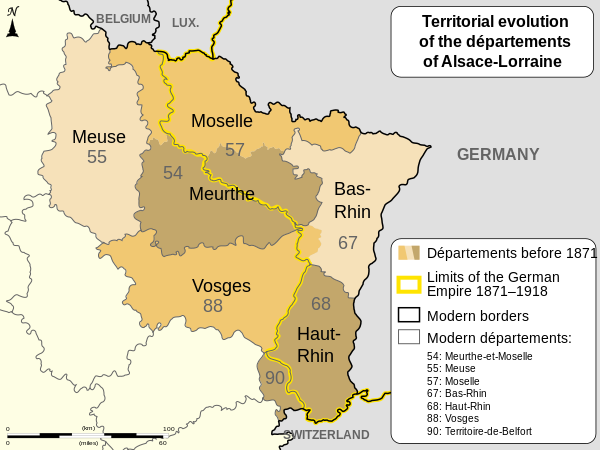
Small caveat: I said that Lorraine was annexed; in fact it was only part of it, the part in which a German dialect is spoken, as in Alsace. The area correlates roughly to the department of the Moselle, about one third of Lorraine. It must be added that the same shameful treatment was inflicted on Luxembourg, contrary to all international law and to all morals.
But now let’s turn to the drama lived by my family from 1939 to 1945. My mother was widowed in 1936 and was the head of a large family of 7 children, 6 boys and a girl, Hélène, born in 1929, the youngest.
 My family lived Mussig, a village of about 900 inhabitants, 8 km east of Sélestat and 10 km from Marckolsheim; it was very near the Rhine River. We had a bakery/grocery store and farmed about 6 hectares of land (14.8 acres). We had a horse and two cows. In 1939 my three older brothers, Marcel, Maurice and Julien were mobilized and sent to the front. Back home we managed as best we could. My brother René, 16, replaced Julien manning the oven and my brother Robert, 13, helped by a very devoted old neighbor, and myself as much as possible, replaced Maurice in the fields. I continued to go to college in Sélestat where classes were held in the basement when there was aircraft alert, which happened quite often, because we were only about fifteen km from the Rhine, that is, the front.
In the summer of 1939, Strasbourg and about a third of the population of Alsace were evacuated towards the interior of the country, near Dordogne. All villages within 10 km of the German border were evacuated. Mussig was not, but a village two kilometers to the east was. Our village was eventually evacuated on June 11, 1940, under the threat of the German offensive on the Rhine. We completed the evacuation in a single day, from morning to evening. We returned non-essential goods to the stores where possible. Then we loaded our car with what we considered essential. We hitched our horse, and got on the evacuation roads of the exodus! We didn't go far, about thirty km, to Ribeauvillé, a beautiful little town at the foot of the Vosges mountains.
On June 15 the Germans attacked on the Rhine, between Schoenau and Neuf-Brisach, and by June 17 they were already in Ribeauvillé! We were dismayed. We stayed a few more days in Ribeauvillé and then returned to Mussig. Although we were happy to return home, it was not pleasant; there was no flour, no groceries, no animals in the stable, or the pigsty, no rabbits, no chickens. And in addition, given the events, there were immediately shortages in all areas.
A great consolation and a great relief, however: my three brothers who had been at war, all at the front, returned safe and sound. Marcel, who had been on the North Front, sergeant with Algerian riflemen, who took part in the battles on the Somme, and the Loire, was not taken prisoner. Julien, who was engaged in fighting near Sedan and Verdun, was taken prisoner; he spent a fortnight (2 weeks) in a prison camp before being released because he was Alsatian.
Maurice, was assigned to the 45/1 Sponeck case-mate (part of the Maginot Line fortifications), a few miles south of Marckolsheim. The casement was located on the dike that flanked the left bank of the Rhine. There was no fighting prior to the big German offensive of June 15th at 9 am between Schoenau and Neuf-Brisach. The battle began with direct artillery fire from the German side of the Rhine. After an hour the casement was pentrated. The Germans then attacked under the protection of artificial fog and, once the Rhine crossed, with flamethrowers.
Immediately the interior of the casement was on fire. The occupants were able to leave because, fortunately for them, they had not locked the exit door. If that had been done, they would all have been burned alive. Two soldiers suffered burns and two were wounded. So they exited the bunker and retreated. They were taken prisoners in the Vosges. After a fortnight Maurice was released because he was Alsatian and came home.
It would have been better for the Alsatians if they were held as prisoner, because they would probably all have survived the war. But how could they suspect what would happen two or three years later, that they would be "forcibly incorporated" into the German army and sent to slaughter on the Russian front? They were released and they preferred freedom to prison camps in Germany; nothing more human, more normal.
Some Alsatian officers, however, refused to be released, their honor dictated that they stay with their men. It hurt them in the end, because they were Alsatians the Germans ordered a "favorable" treatment for them. They were put in concentration camps and they did not come back.
The situation in Alsace-Lorraine (departments of Haut-Rhin, Bas-Rhin and Moselle), and in Luxembourg as well, was identical.
The Armistice of June 22, 1940 was the provisional end of the war. To our great consolation when we returned home, after our evacuation to Ribeauvillé; my three older brothers Marcel, Maurice and Julien all returned safe and sound after fighting with the French Army.
We returned to civilian life and work, Marcel to Metz, Maurice and Julien to Mussig. I went back to college. Now under the Germans, my bachelor degree considered invalid. I was required to pass the German equivalent of the baccalaureate. All instruction in all subjects was given in German. There was no teaching in French as it was forbidden to speak French, under penalty of arrest and confinement to the Schirmeck "reeducation" camp. In June 1941, I passed the "Reifeprüfung" (Graduation Exam) with "High Honors".
I wanted to continue studying, thinking that it would always benefit me. I enrolled at the University of Strasbourg, in geography, English and, inevitably, German. The teachers of English were good, those of German very good, that of French on the other hand lousy, so that everyone dropped that class. I boarded with my uncle and godfather Marcel Schwartz, who lived in Schiltigheim, a suburb of Strasbourg.
In the clauses of the armistice there was no reference to the Alsatian-Lorraine departments and their population. They should have suffered the same fate of the other occupied French territories. It was not so because they were simply annexed by Germany, not officially but defacto. From June 1940 the French government was replaced by a German government, the local officials replaced by officials from Germany.
As early as July 24, 1940, the border markers were moved and put back along the route of 1870. They were even preceded by a glacis (a slope that runs downward from a fortification), a forbidden zone, about 3 km wide. Anyone who was there while not living there, was suspicious and immediately arrested.
Political parties and all associations were dissolved and banned. The whole civil government was reorganized based on the the German model. At the head of each community was a "Bürgermeister" (mayor) appointed by the head of the "Zivilverwaltung" (civil administration), namely Robert Wagner for Alsace. In my village of Mussig, they appointed Joseph Will, son of Germans who settled in Alsace after 1870 and who had been allowed to stay there after 1918.
The government reorganization was followed rapidly by the introduction of German law and a judicial reorganization. The entire Nazi police apparatus was immediately establish with the utmost care. German was proclaimed the official language and the only language allowed to be spoken and written. French was no longer taught in primary school or in any college or high school. The names of the villages were Germanized as were all the first names. We could no longer be called René or Jacques but instead were called Reinhard and Jakob. Cafes, grocery stores, bakeries, etc. had to be displayed in German. By pressure or by decrees, or by laws, people were obliged to join associations which were created and which were automatically qualified as national socialists. For example, the peasants: if they wanted to obtain fertilizers or seeds, they had to join the national socialist peasant association.
By order of January 2, 1942 all young people were forced to enter the Hitlerjugend (Hitler Youth organization) under penalty of punishment against parents. By the decree of August 23, 1942 the Alsatians, Lorrainers and Luxemburgers were granted German citizenship and as a logical consequence on August 25th, rendering military service compulsory in the Wehrmacht (German Army).
We were then gradually forcibly incorporated into the RAD ("Reichsarbeitsdienst"), a sort of pre-military service, and then into the German army. Resistors were automatically considered deserters and the most severe penalties were applied to themselves and to their families who were displaced to Germany and Poland. It was terrible for us, we had to fight alone, with the bitter feeling of being completely abandoned by the French government. What does one do when faced of the threat of being incorporated into the German Army?
Apparently the Vichy government protested the treatment of Alsace Lorraine. By his own admission at the Nuremberg trial, he never made it publicly, so no one ever knew, especially not in Alsace. We had to fight alone, with the bitter feeling of being completely abandoned by official France. It was terrible for us. What to do in the face of the threat of being incorporated into the German army?
It was not easy to clandestinely cross the new border of the Vosges Mountains into the occupied zone, then to cross into the free zone. It was very dangerous, especially for an Alsatian deserter. And then, their families were threatened of reprisals, and deportation.
The first of us to take this route, after much discussion with the rest of the family, was my brother René, aged 19. He was the first to fall under the compulsory incorporation order. It was true that he no longer lived in Mussig, but worked as a bakery worker in Strasbourg. He was required to join the HitlerJugend. When questioned in Strasbourg he told them he was officially on Mussig's role, and in Mussig he said he was on Strasbourg's role.
He found a network of smugglers and, on January 11, 1942, went to Metz, to our brother Marcel. Marcel's father-in-law, more precisely his future father-in-law, had been deputy head of Metz railroad station and knew a network of smugglers. René, assisted by this network of smugglers escaped to the occupied zone. In Nancy he was given false papers and later he went into the free zone to take refuge with the Burkel family (vague cousins), farmers at Le Fleix near Sainte Foy-la-Grande. Later some bad luck forced him into the "youth camps."

On October 11th, 1943 in response to some French resistance activities in the local area, the youth camp was surrounded by German police. They were arrested and taken to the barracks of the 92nd Infantry Regiment in Clermont-Ferrand where they were held as hostages. They were threatened to be executed if any additional German soldiers were killed because of the French resistance.
One day when René was working with others on the edge of an airfield, he knocked the guard down and escaped. Upon arriving at the house of a railway gatekeeper, he explained his situation. The gatekeeper put him on a freight train heading towards Lyon after giving him some money.
Since he had a little money, after arriving in Lyon, he continued on to Cluny. In Cluny he met up with our brother Marcel who had also fled to the free zone with his wife Marthe, instead of being forcibly incorporated into the German Army.
René worked on a farm in the Cluny area and then entered the Maquis of Cluny (French Resistence Cell). When the region was liberated he enlisted for the duration of the war in the "Commando de Cluny", one of the spearheads of the first French army. I, myself, had been in this army for more than a year, and at many of the same places, but we knew nothing of each other.
He took an active part in the fighting in the Doubs. He was a machine gunner, firing the FM (machine gun), his comrade André Perrot was his charger (assistant). On the morning of November 19 during an offensive near the village of Frahier, his comrade was killed on the spot. The village was taken and in the evening the Germans won the battle.
Next came the capture of Belfort and the entry into Alsace. There he again participated in hard fights, with many dead near Burbach-le-Haut. Then there was fighting on the Hundsrück above Thann and Ramersmatt.
He volunteered for a very dangerous mission, to protect a bridge. All alone, with his FM, he saved the bridge that the Germans were preparing to destroy. His conduct earned him the Croix de Guerre Croix de Guerre (War Cross) and the Médaille militaire (Military medal). He spent Christmas and New Year in Thann, then departed for Germany. They crossed the Rhine at Guermersheim in canoes. There was hardly any German resistance. They occupied Neustadt, Biberach, etc., and then ended the war on the shores of Lake Constance, precisely where I was also at the same time, but without knowing it and without us meeting. I was demobilized on May 25 and René in November 1945.
I forgot to say that after René escaped from Alsace our family was not bothered. René was not living in Mussig but in Strasbourg, his escape was not detected. The authorities in Strasbourg believed he was still on the lists of Mussig, In Mussig he had made them believe that he was registered in Strasbourg.
After Marcel and his wife escaped from Lorraine on May 7, 1943, his father-in-law was arrested and deported to a concentration camp in Dachau. He returned in 1945, but oh in such a state! My mother was not deported; but she was interrogated for hours by the Gestapo, and released on bail after paying a large bond, and entered on a "watch list" that was discovered in 1945. That she was not deported was probably because she could argue that if she had two deserters, she also had three sons, Maurice, Julien, and myself still at the time in the German army, on the Russian front. We did not dare. The military hierarchy of the three sons in the army would also have, no doubt, protested, because the German army was not 100% Nazi, especially more in 1943, and had a certain independence, a certain dignity, to defend face to the all-powerful Nazi party.
In 1943 there were three of us in the German army. I want to talk first about Maurice and Julien. They were both forced into the Wehrmacht on April 19, 1943. The day before they had a farewell dinner attended by our cousin Maria (Mimi) Schwartz of Strasbourg. Also present were Marcel's future father-in-law, Mr. Alexis Hory, and a German refugee from the Ruhr, who had been forced to live with her daughter. During the meal we made the mistake of speaking politics, worse still in French, in the presence of this German. It was said that the Germans were going to lose the war, etc., etc. Mom, cautious, did not say anything, and tried to stop these discussions. She suspected what would happen.
Indeed, the next day, the German denounced everyone. My brothers, who had not said much, had left for the army, and M. Hory for Metz. My cousin Mimi was arrested and deported to the Struthof concentration camp in Schirmeck. She was, however, released after a few months. My mother was "grilled" by the Gestapo but they could not fault her, and her two sons had just left for the war. She was left at liberty but on bail. After all this, the German did not have the nerve to stay with Mom, and left Mussig.
The next day Maurice and Julien left for the German army, that is to say the war. We know little about Julien's tribulations. We had no news of each other; and Julien, who did not returned from the war, could not tell us anything. He wrote to Mama who was still in Mussig with Robert and Helen, but after the war we spoke very little about it. The memories were too painful. The last letter to Mom was dated November 12, 1944, from Naumburg. He was pronounced dead on February 2, 1945.
As for Maurice, when he came home, he put his memories in writing, but without much detail because thinking back to those terrible years hurt him too much.
As Maurice had completed his military service before the war, and then served in the war with in the French army, it was judged that he did not need additional military training. He was sent directly to the front, on the front line at Witebsk in Russia. On December 15, 1943 they were encircled, but finally managed to break free. Other hard fights took place near Casimirova and Polota, then it was the retreat towards Dorpat in September 1944. There he was wounded for the first time by a shrapnel in the left knee. This wound required two surgeries. He passed through four military hospitals, the first to be evacuated before the advance of the Russian armies. Once he was cured, he was sent to the front again, first to Steinau / Oder, then to another place. He was wounded again on 2 February 1945 in the left heel and was first hospitalized in Ulm, then from 10 March 1945 to 25 May 1945, in Geislingen, where he was released by the Americans. He returned to Mussig on May 25, 1945.
Since then, not a day has passed without his memory of those two terrible years spent in the German uniform, that is to say the enemy, to participate in a war that was not his. In spite of this at the risk of his own life, he saved the life of a German seriously wounded at the front line. Whatever the circumstances, he was a man. What he can not forget were those two winters in Russia with temperatures of up to -40 degrees and with so much snow. He can not see me without talking to me about all this, because he knows that, more than anyone else, I can understand him because I lived about the same thing. He knows, and he says it, that he had an extraordinary luck of coming back alive, and that his two wounds did not handicap him for life.
It was not very painful, but, when I lifted my hand to the back of my neck, I felt a fragment of metal planted in the bottom of my skull; the blood ran along my hand. This shard tore the bottom of my helmet off. That helmet that I hated so much had just saved my life, for the wound was about a centimeter into the cerebellum.
A comrade rescued me, I do not know how. I only remembered that after 200 or 300 meters we stopped, sheltered from the sight of the Russians, in a mass of trees and hedges, and he began to make a makeshift dressing. The dressing was scarcely completed, when we heard the Russians nearby. We were hidden and they didn’t see us; we evidently didn’t move and then, oh divine surprise, we heard them leave. We started to hope and then realized; the Russians had passed by us and were now circling back. They tightened their circle, but we were outside the circle and not at risk for the moment. We withdrew as far as possible from the front.
I was operated on in what must have been a schoolroom, sitting on a chair, a soldier holding me by one arm on the left and another on the right. I was given a local anesthesia and the shell fragment was removed. It didn’t hurt me, but I felt and heard the cracking when they removed the small scrap metal that was planted in my skull. At least two surgeons were there, operating in this room, on simple tables. I spent the night in a room, on the floor, with other wounded soldiers, some who had been operated on and, others who had not because of the severity of the wounds to the abdomen or the chest. One of them died that night, nobody noticed.
The next day I was evacuated by truck, then by sanitary train (military medical services including ambulances, field hospitals and camp infirmaries) to Poland where I spent six weeks in a military hospital in Sierdz, not far from Lodz, I think.
My wound healed very quickly, much too fast to my liking, and in early December, I was sent home to convalesce for two or three weeks.
I was very happy to be among my family, my mother, my brother Robert, my sister Helene. I had news of my brothers Maurice and Julien, both of them on the Russian front, but we had no news of Marcel and Rene. We weren't too worried about those two because; we thought they were safe.
I'm was happy to be in civilian clothes, no longer to wearing those dirty boots and the uniform I so hated. I felt like a different man. I learned of others who were dead or missing in Russia and I was a little surprised to be there, alive, to have returned from this hell.
The days passed quickly, and when I thought about returning to the German army and the Russian front that I so feared, I again thought about deserting, trying to make it to Switzerland and escape beyond the Vosges. I thought about it, knowing that it will not be possible, and it tore at my heart. Terrible dilemma, an impossible case of conscience. Taking risks for oneself is relatively easy; putting extreme risks on my family, to my mother, sister, brother, was quite another thing. The risks were terribly real. We knew what happened to Marcel's father-in-law after Marcel's escape with his wife: the concentration camp! And the same reprisals my mother narrowly escaped. It was morally impossible for me to desert the army under these circumstances. I therefore resigned myself to donning the German uniform and putting on the boots.
I should have returned to the barracks in Brno on December 23 or 24, which is Christmas Eve, but I could not resign myself to it. I decided to spend Christmas with my family, damn the consequences. I left on the 26th and arrived at barracks on the 27th, four days late. In fact, I was already listed as deserter and answerable to the council of war. I was summoned to the Colonel's room. I explain to him that I had been sick, that my mother had not been well. I do not think he believed me, and I do not know if he tried to verify my statements by contacting Mussig.
In any case, I was not court-martialed, without a doubt because I returned after fighting on the Russian front where I was wounded, and I returned on my own to the barracks. They hadn’t needed to look for me. The colonel was "indulgent" with me and sentenced me to four weeks in prison beginning on December 31st, 1943 at 13 hours. This sentence made me neither hot nor cold, it it was rather light and with a happy heart that I entered prison on December 31st at 1 pm.
The prison was a large building near the entrance to the barracks. The cells, ten or twelve on either side of a corridor, were upstairs. The staircase was closed by strong gates, at the bottom and at the top. The cells were 2 meters by 3 meters, with a thick solid door with a peephole which allowed the guard to monitor us. At the other end, was a small window with big bars which provided us a bit of light. The only "furniture" was a wooden bench to sit or sleep on.
During those four weeks I never went out in the open air. I went out into hallway in the morning to wash and to use the toilet, and in the evening to get two blankets which were returned each morning. The food was limited, in the morning, there were a few slices of bread and a bowl of beverage which was coffee only by name. One day in three I was entitled to a normal meal. Being a light eater, as I said before, it satisfied me.
I wasn’t bored; I was fairly satisfied. Being a Frenchman in a German prison, I was in my place. I no longer felt myself in the army, no more helmets and boots, no military exercises, no Germans to command me; It was silence, calm and I felt in perfect harmony with my conscience. I would have happily remained in prison until the end of the war, if they would have left me there.
I was not bored, I had managed to sneak in a little Goethe book, "Gedanken und Erinnerunqen" (Thoughts and Memories) into my cell. This allowed me to reflect and to philosophize for hours, all day long. One of the guards finally realized that I had this little book, but he did not say anything and left it with me.
At the end of January I was released and returned to life in the barracks, The majority of my fellow soldiers were mostly Austrians, I was the only Alsatian. The fact that I had been in the brig did not result in any special treatment, no bullying, no insults. I had the impression that they did not judge me, not even my superiors. I was not of particularly notice, either good or bad.
Towards the end of April 1944, we made preparations to depart for the front. The big question: which front? And it was a great relief when we realized that we were not driving east, but south through Bavaria and then the Alps through the Brenner Pass. And then we were in Italy.
For me, it was a dream come true, although under foul conditions. I saw orange trees, olive trees, and Roman ruins still in relative good condition. It would have been exciting, if I had not been a German soldier! The train took us further south, about fifty kilometers north of Rome to Bracciano, on the lake of the same name. We lodged in a beautiful and charming villa on the shore of the lake. As a radio telegraphist I was assigned to the company's command post. We spent about two months, doing exercises and most importantly, thinking about the occupation. We had little contact with the population that avoided us.
One day a small group of us were sent to Florence in a van, a non-commissioned officer, another soldier and myself. I was the interpreter for I had learned a little Italian. Our mission was to make purchases for the company's staff. We spent two days in Florence to make these purchases and also to visit the city.
Our return almost ended badly; we were spotted by an American airplane that flew by and shot at us profusely. When we saw him heading towards us, we immediately stopped the van and got out. We stretched out in a small ditch flanking the road. They strafed us with a machine-gun; and came back at us a second time. Fortunately none of us three was touched. The van was, but not the engine, so we continued our return unharmed to Bracciano.
At the end of May, we suddenly received orders to prepare to leave. The Americans, and the French, had launched a a major offensive in the area south of Rome and we were being sent there as troop reinforcements. Soon we were in the Albanian mountain region, and practically at the front. We were in trucks and we soon heard the sound of bitter fighting in front of us, and on our left and on our right. We were about to be encircled so we turned around. We extricated ourselves completely; it was night and we drove, I do not know how long and I do not remember what happened next.
I have an incredible hole in my memory, I only remember that I found myself alone, wandering more or less in the region between Rome and the sea, in Ostia in particular. I hitchhiked, trying to avoid the "Feldgendarmerie", the German military police. I was not the only one wandering this way, for the German Army was in disarray.
One evening I found myself in Bracciano near a field kitchen. I needed to eat. There were about fifty of us scattered around. The next day we were ordered to withdraw to new positions. It was then I decided the time had come; that it is absolutely necessary to find a way to escape, as discreetly as possible.
At nightfall, we left Bracciano by a small road in a northerly direction. We were on foot; there were no German vehicles anywhere to be seen. I acquired a bicycle, from where I no longer know and was armed with a single pistol. We were walking through a large wooded area. The road was curvy and I arranged to be at the tail end of the troops. At the beginning of a turn I blew the chain of my bicycle and then pretended to put it back on.
As soon as the troops were out of sight, I threw the bike behind a hedge and and sank into the trench. No one spotted me run away; at least I didn’t think so. I hid myself among some rocks which were nearby, where I spent the night. It was the night of June 5th, 1944.
Towards the middle of the night, I heard the noise of trucks and tanks moving in the distance on the road. It could only be the Americans, because for two days I had not seen any German trucks or tanks in the area. In the morning, about eight or nine o'clock, I left my hiding-place and cautiously went looking for them. A civilian whom I met confirmed that it was indeed the Americans. I asked him to take me to them, which he willingly did. For me, it was much more reassuring to be accompanied.
I was a prisoner of the Americans. Knowing English, it was easy for me to explain my case. I was well-treated and I ate excellent white bread and "beans" for the first time. I wouldn’t appreciate the canned beans for long, because we ate them every day.
The next day or the day after, a captain of the French army, an Alsatian named Altdorfer, if I remember correctly, came to "liberate" me from the Americans. Following an interrogation, we left the American camp. We left for Aversa, north of Naples, where the French Expeditionary Corps of Italy was based. Following a change of uniform, a shower, and vaccinations, I was incorporated into the French army. I found myself with a dozen other Alsatians and Lorrainers, who had also been forcibly conscripted into the German Army, and were lucky enough to be sent to Italy.
During the ten days that followed we completed an encoder training class, then were assigned to the HQ of the French Expeditionary Corps in Italy, and advanced northward towards the front. The HQ was still quite far behind the front. Obviously they could not send us to the front line, or we risked falling back into the hands of the Germans. Our work was very interesting, because reports from the different divisions reached us every day and we were the first to know the situation on the front. We also communicated with the government in Algiers, and later in Paris.
We were pleasantly surprised, that they placed so much confidence in us, we who had come from the opposing camp and who they little knew. True Germans could have pretended to be Alsatians-Lorrainers and infiltrated the French army in this way, to indulge in espionage and sabotage. We knew a lot of secret information, we knew at least four weeks in advance, when and where the landing would take place in Provence, in the south of France. It's was not nothing.
We moved beyond Siena, in the vicinity of Poggibonsi, about 40 km south of Florence. Troop advances stopped; but we didn’t remain long because by the end of July all the French troops were withdrawn from the front. We met up in Naples and Aversa where we waited in anticipation of our embarkation of the Allied landing on the coast of Provence. We waited at least four weeks and had absolutely nothing to do.
We visited Naples and its surroundings, Pozzuali and its volcanoes. Twice we took the train to Pompei, One day, two friends (Muller and Szymanski) and I, decided to visit Rome. After breakfast we set off hitchhiking, and arrived in Rome around eight o'clock in the evening, having been picked up by 14 different vehicles. We learned of the liberation of Paris, It was August 24th, 1944. The next day we visited Rome; we went to the top of St. Peter's and were received by the Pope. On the 26th we returned to Naples, and, to our great surprise there was no one there.
What a calamity, we thought they had embarked without us! Immediately we started looking for them, hoping that they might still be boarding ships. In the port of Naples, nothing; at the port of Bagnoli, north of Naples, we finally found them, on the docks, in front of the ships, waiting. Phew! All our comrades were there, and they had brought our gear. Prudently, they had not mentioned our absence and our leaders were unaware of it. Everything ended well, but we were lucky.
We embarked the same day and left. We were not the first to leave for France. The first ships arrived on the 15th of August. Our convoy was important; we had a large number of Liberty Ships – escorted by warships, on all sides. It was impressive and we were all extremely happy to sail for our homeland and to actively participate in its liberation.
We were three days at sea and finally landed near Sainte-Maxime, on the beach of La Nardelle. During the journey there was no alerts of enemy planes or submarines. At La Nardelle our boats landed on the beach; their fronts opened, a kind of bridge was lowered and, perched on our trucks, we landed without even getting our feet wet.
We headed north on the Napoleon road, to Aix-en-Provence, near Grenoble. The first few towns had already been liberated. This was not the case of Villefranche-sur-Saône or Macon where we were cheered. We stayed some time in Macon. I was about twenty kilometers from Cluny where my brother Marcel and his wife had taken refuge and where my brother Rene was aiding the Maquis (French Resistance guerrilla fighters). I did not know it at the time, having had no news of them for a long time. We were so very close to each other and totally unaware of it.
As our troops pushed the Germans back, we moved, alternating between the front and the rear through the following towns of Dijon, Besancon, Montbeliard, Belfort, Guebwiller, Palatinate, and Karlsruhe. On the 5th of May, the day of the armistice, we moved towards Lindau on the shores of Lake Constance. This was where I was demobilized on May 25, 1945.
When we were in Belfort, I was very worried about my family in Mussig. We knew that Selestat had been liberated, but our village of Mussig only 8 km away, was not and was therefore was under artillery fire and exposed to possible American bombing. On February 1st, Mussig was liberated. From the end of November until that date, the residents had lived in the cellars.
As soon as I could, I went to "my house," where I found my mother, my brother Robert, and my sister Helene, all three in good health. I also had news of my brother, Rene, who had previously visited them. It was impossible to describe how happy we were to find ourselves in good health. But we still had no news of Maurice and Julien.
-----------------------------------------------
 I returned to Mussig on May 25, 1945, the same day as my brother Maurice. Julien did not return. He was declared dead on February 3rd, 1945. Maurice resumed his work as a farmer. I helped Rene at the grocery store. The goods were being rationed and quite scarce, we had to search everywhere for them.
For two years, I worked for the administration of the town hall. Once a week, I went to college in Strasbourg, and resumed my studies as much as possible. It was not ideal and could not last. Rene was to be married and I would be in they way if I stayed in the house. To continue working for the town administration didn’t suit me either.
Marcel advised me to seek a position as a répétiteur (coach/ proctor) for public education. In October 1947, I was appointed as a répétiteur at Chalon-sur-Saone. This allowed me to start serious university studies at the University of Dijon. At the beginning of 1948, I transferred to Besancon, a university town. In two years, from 1947 to 1949 I passed my license and in 1950 in obtained the CAPET, Certificate of Aptitude to the Technical Teaching (teaching certificate).
In July 1950 I married Gilberte Benichou, I was appointed Professor of German at the technical college of Saintes in Charente-Maritime, and became a resident of that city. Gilberte and I had three children. In 1973, I was married a second time to Genevieve Coumailleau.
Edmond died in Saintes on 12 November 1991.
The following is an autobiographical account written by Edmond Reppel between 1990 and 1991. I, Margaret have translated it from French to English. Any errors are unintended. I have added a few notes for greater clarity, they are written in red italics.
-----------------------------------------------------
Edmond Reppel - Memoirs of a "Malgré Nous"

"Yes, I'm going to get started, I have decided to tell the story of the tragedy experienced by my family from 1939 to 1945, as experienced by so many other families in Alsace and Lorraine. Our children and grandchildren need to know, that most people should know what happened, never forget and that it should never happen again. The risk of forgetting is great ...
We have forgotten the war of 1870, and the much more terrible and more deadly War of 1914-1918, not to mention the previous wars. History did not stop in 1918, nor in 1945, and it continues now. What happened so many times can happen again, and with modern armaments this can be the apocalypse, wherever war breaks out.
The last two wars were terrible, the wars of the future will be infinitely worse still. It is true that one must have been at war on the front line, to know what that is like. And when one has lived it they are obsessed with it the rest of their life. I hope that by writing my memories of this period I will free myself a little.
There is a thought that comes to mind, I don't remember who said it, "Every man who dies is a library that burns." I do not pretend to be a great library, but I still want to put in black and white what I know about myself and my family; I will try to save from oblivion what I can.
All my brothers lived the same drama, and I will relate what I know about them in relation to this period. Unfortunately, four of them have already left us and, of the six boys in our family, in 1991 there are only two remaining, my brother Maurice and myself. Julien, did not return from the war, René, died in 1982 at the age of 59, Marcel died in 1987 at the age of 73 and Robert, who was the youngest, died in 1990 at the age of 61. Maurice was born in 1916 and myself in 1921. We do not know when our turn will come.
I write also because, in general, the rest of France does not know or only has a vague idea of what exactly happened in Alsace-Lorraine during the last world war, between June 1940 and our liberation in 1945. Even in Alsace-Lorraine the younger generations are often ignorant of it.

During this period, the Vichy government did not say a word, either on the radio or in the press, about what was happening in these two provinces. It was as if they were no longer or had never been part of France. To appease the Germans, they pretended that Alsace and Lorraine were not "occupied", but "annexed", that is to say, fully integrated into Hitler's Germany. The Vichy government claimed to have protested to the Germans against this state of affairs, but if there were any protests, they were never public and nobody ever knew anything about it.

Small caveat: I said that Lorraine was annexed; in fact it was only part of it, the part in which a German dialect is spoken, as in Alsace. The area correlates roughly to the department of the Moselle, about one third of Lorraine. It must be added that the same shameful treatment was inflicted on Luxembourg, contrary to all international law and to all morals.
But now let’s turn to the drama lived by my family from 1939 to 1945. My mother was widowed in 1936 and was the head of a large family of 7 children, 6 boys and a girl, Hélène, born in 1929, the youngest.
The Battle of France
 My family lived Mussig, a village of about 900 inhabitants, 8 km east of Sélestat and 10 km from Marckolsheim; it was very near the Rhine River. We had a bakery/grocery store and farmed about 6 hectares of land (14.8 acres). We had a horse and two cows. In 1939 my three older brothers, Marcel, Maurice and Julien were mobilized and sent to the front. Back home we managed as best we could. My brother René, 16, replaced Julien manning the oven and my brother Robert, 13, helped by a very devoted old neighbor, and myself as much as possible, replaced Maurice in the fields. I continued to go to college in Sélestat where classes were held in the basement when there was aircraft alert, which happened quite often, because we were only about fifteen km from the Rhine, that is, the front.
In the summer of 1939, Strasbourg and about a third of the population of Alsace were evacuated towards the interior of the country, near Dordogne. All villages within 10 km of the German border were evacuated. Mussig was not, but a village two kilometers to the east was. Our village was eventually evacuated on June 11, 1940, under the threat of the German offensive on the Rhine. We completed the evacuation in a single day, from morning to evening. We returned non-essential goods to the stores where possible. Then we loaded our car with what we considered essential. We hitched our horse, and got on the evacuation roads of the exodus! We didn't go far, about thirty km, to Ribeauvillé, a beautiful little town at the foot of the Vosges mountains.
On June 15 the Germans attacked on the Rhine, between Schoenau and Neuf-Brisach, and by June 17 they were already in Ribeauvillé! We were dismayed. We stayed a few more days in Ribeauvillé and then returned to Mussig. Although we were happy to return home, it was not pleasant; there was no flour, no groceries, no animals in the stable, or the pigsty, no rabbits, no chickens. And in addition, given the events, there were immediately shortages in all areas.
A great consolation and a great relief, however: my three brothers who had been at war, all at the front, returned safe and sound. Marcel, who had been on the North Front, sergeant with Algerian riflemen, who took part in the battles on the Somme, and the Loire, was not taken prisoner. Julien, who was engaged in fighting near Sedan and Verdun, was taken prisoner; he spent a fortnight (2 weeks) in a prison camp before being released because he was Alsatian.
 |
| WWII German flamethrower |
Maurice, was assigned to the 45/1 Sponeck case-mate (part of the Maginot Line fortifications), a few miles south of Marckolsheim. The casement was located on the dike that flanked the left bank of the Rhine. There was no fighting prior to the big German offensive of June 15th at 9 am between Schoenau and Neuf-Brisach. The battle began with direct artillery fire from the German side of the Rhine. After an hour the casement was pentrated. The Germans then attacked under the protection of artificial fog and, once the Rhine crossed, with flamethrowers.
Immediately the interior of the casement was on fire. The occupants were able to leave because, fortunately for them, they had not locked the exit door. If that had been done, they would all have been burned alive. Two soldiers suffered burns and two were wounded. So they exited the bunker and retreated. They were taken prisoners in the Vosges. After a fortnight Maurice was released because he was Alsatian and came home.
It would have been better for the Alsatians if they were held as prisoner, because they would probably all have survived the war. But how could they suspect what would happen two or three years later, that they would be "forcibly incorporated" into the German army and sent to slaughter on the Russian front? They were released and they preferred freedom to prison camps in Germany; nothing more human, more normal.
Some Alsatian officers, however, refused to be released, their honor dictated that they stay with their men. It hurt them in the end, because they were Alsatians the Germans ordered a "favorable" treatment for them. They were put in concentration camps and they did not come back.
The situation in Alsace-Lorraine (departments of Haut-Rhin, Bas-Rhin and Moselle), and in Luxembourg as well, was identical.
June 1940 – The Armistice
The Armistice of June 22, 1940 was the provisional end of the war. To our great consolation when we returned home, after our evacuation to Ribeauvillé; my three older brothers Marcel, Maurice and Julien all returned safe and sound after fighting with the French Army.
We returned to civilian life and work, Marcel to Metz, Maurice and Julien to Mussig. I went back to college. Now under the Germans, my bachelor degree considered invalid. I was required to pass the German equivalent of the baccalaureate. All instruction in all subjects was given in German. There was no teaching in French as it was forbidden to speak French, under penalty of arrest and confinement to the Schirmeck "reeducation" camp. In June 1941, I passed the "Reifeprüfung" (Graduation Exam) with "High Honors".
I wanted to continue studying, thinking that it would always benefit me. I enrolled at the University of Strasbourg, in geography, English and, inevitably, German. The teachers of English were good, those of German very good, that of French on the other hand lousy, so that everyone dropped that class. I boarded with my uncle and godfather Marcel Schwartz, who lived in Schiltigheim, a suburb of Strasbourg.
In the clauses of the armistice there was no reference to the Alsatian-Lorraine departments and their population. They should have suffered the same fate of the other occupied French territories. It was not so because they were simply annexed by Germany, not officially but defacto. From June 1940 the French government was replaced by a German government, the local officials replaced by officials from Germany.
 |
| German control post |
Political parties and all associations were dissolved and banned. The whole civil government was reorganized based on the the German model. At the head of each community was a "Bürgermeister" (mayor) appointed by the head of the "Zivilverwaltung" (civil administration), namely Robert Wagner for Alsace. In my village of Mussig, they appointed Joseph Will, son of Germans who settled in Alsace after 1870 and who had been allowed to stay there after 1918.
The government reorganization was followed rapidly by the introduction of German law and a judicial reorganization. The entire Nazi police apparatus was immediately establish with the utmost care. German was proclaimed the official language and the only language allowed to be spoken and written. French was no longer taught in primary school or in any college or high school. The names of the villages were Germanized as were all the first names. We could no longer be called René or Jacques but instead were called Reinhard and Jakob. Cafes, grocery stores, bakeries, etc. had to be displayed in German. By pressure or by decrees, or by laws, people were obliged to join associations which were created and which were automatically qualified as national socialists. For example, the peasants: if they wanted to obtain fertilizers or seeds, they had to join the national socialist peasant association.
By order of January 2, 1942 all young people were forced to enter the Hitlerjugend (Hitler Youth organization) under penalty of punishment against parents. By the decree of August 23, 1942 the Alsatians, Lorrainers and Luxemburgers were granted German citizenship and as a logical consequence on August 25th, rendering military service compulsory in the Wehrmacht (German Army).
We were then gradually forcibly incorporated into the RAD ("Reichsarbeitsdienst"), a sort of pre-military service, and then into the German army. Resistors were automatically considered deserters and the most severe penalties were applied to themselves and to their families who were displaced to Germany and Poland. It was terrible for us, we had to fight alone, with the bitter feeling of being completely abandoned by the French government. What does one do when faced of the threat of being incorporated into the German Army?
Apparently the Vichy government protested the treatment of Alsace Lorraine. By his own admission at the Nuremberg trial, he never made it publicly, so no one ever knew, especially not in Alsace. We had to fight alone, with the bitter feeling of being completely abandoned by official France. It was terrible for us. What to do in the face of the threat of being incorporated into the German army?
It was not easy to clandestinely cross the new border of the Vosges Mountains into the occupied zone, then to cross into the free zone. It was very dangerous, especially for an Alsatian deserter. And then, their families were threatened of reprisals, and deportation.
My brother René - Escape to Free Zone
The first of us to take this route, after much discussion with the rest of the family, was my brother René, aged 19. He was the first to fall under the compulsory incorporation order. It was true that he no longer lived in Mussig, but worked as a bakery worker in Strasbourg. He was required to join the HitlerJugend. When questioned in Strasbourg he told them he was officially on Mussig's role, and in Mussig he said he was on Strasbourg's role.
He found a network of smugglers and, on January 11, 1942, went to Metz, to our brother Marcel. Marcel's father-in-law, more precisely his future father-in-law, had been deputy head of Metz railroad station and knew a network of smugglers. René, assisted by this network of smugglers escaped to the occupied zone. In Nancy he was given false papers and later he went into the free zone to take refuge with the Burkel family (vague cousins), farmers at Le Fleix near Sainte Foy-la-Grande. Later some bad luck forced him into the "youth camps."

On October 11th, 1943 in response to some French resistance activities in the local area, the youth camp was surrounded by German police. They were arrested and taken to the barracks of the 92nd Infantry Regiment in Clermont-Ferrand where they were held as hostages. They were threatened to be executed if any additional German soldiers were killed because of the French resistance.
One day when René was working with others on the edge of an airfield, he knocked the guard down and escaped. Upon arriving at the house of a railway gatekeeper, he explained his situation. The gatekeeper put him on a freight train heading towards Lyon after giving him some money.
Since he had a little money, after arriving in Lyon, he continued on to Cluny. In Cluny he met up with our brother Marcel who had also fled to the free zone with his wife Marthe, instead of being forcibly incorporated into the German Army.
René worked on a farm in the Cluny area and then entered the Maquis of Cluny (French Resistence Cell). When the region was liberated he enlisted for the duration of the war in the "Commando de Cluny", one of the spearheads of the first French army. I, myself, had been in this army for more than a year, and at many of the same places, but we knew nothing of each other.
He took an active part in the fighting in the Doubs. He was a machine gunner, firing the FM (machine gun), his comrade André Perrot was his charger (assistant). On the morning of November 19 during an offensive near the village of Frahier, his comrade was killed on the spot. The village was taken and in the evening the Germans won the battle.
Next came the capture of Belfort and the entry into Alsace. There he again participated in hard fights, with many dead near Burbach-le-Haut. Then there was fighting on the Hundsrück above Thann and Ramersmatt.
He volunteered for a very dangerous mission, to protect a bridge. All alone, with his FM, he saved the bridge that the Germans were preparing to destroy. His conduct earned him the Croix de Guerre Croix de Guerre (War Cross) and the Médaille militaire (Military medal). He spent Christmas and New Year in Thann, then departed for Germany. They crossed the Rhine at Guermersheim in canoes. There was hardly any German resistance. They occupied Neustadt, Biberach, etc., and then ended the war on the shores of Lake Constance, precisely where I was also at the same time, but without knowing it and without us meeting. I was demobilized on May 25 and René in November 1945.
I forgot to say that after René escaped from Alsace our family was not bothered. René was not living in Mussig but in Strasbourg, his escape was not detected. The authorities in Strasbourg believed he was still on the lists of Mussig, In Mussig he had made them believe that he was registered in Strasbourg.
After Marcel and his wife escaped from Lorraine on May 7, 1943, his father-in-law was arrested and deported to a concentration camp in Dachau. He returned in 1945, but oh in such a state! My mother was not deported; but she was interrogated for hours by the Gestapo, and released on bail after paying a large bond, and entered on a "watch list" that was discovered in 1945. That she was not deported was probably because she could argue that if she had two deserters, she also had three sons, Maurice, Julien, and myself still at the time in the German army, on the Russian front. We did not dare. The military hierarchy of the three sons in the army would also have, no doubt, protested, because the German army was not 100% Nazi, especially more in 1943, and had a certain independence, a certain dignity, to defend face to the all-powerful Nazi party.
My brothers Maurice & Julien - Drafted into the Wehrmacht
Indeed, the next day, the German denounced everyone. My brothers, who had not said much, had left for the army, and M. Hory for Metz. My cousin Mimi was arrested and deported to the Struthof concentration camp in Schirmeck. She was, however, released after a few months. My mother was "grilled" by the Gestapo but they could not fault her, and her two sons had just left for the war. She was left at liberty but on bail. After all this, the German did not have the nerve to stay with Mom, and left Mussig.
The next day Maurice and Julien left for the German army, that is to say the war. We know little about Julien's tribulations. We had no news of each other; and Julien, who did not returned from the war, could not tell us anything. He wrote to Mama who was still in Mussig with Robert and Helen, but after the war we spoke very little about it. The memories were too painful. The last letter to Mom was dated November 12, 1944, from Naumburg. He was pronounced dead on February 2, 1945.
As for Maurice, when he came home, he put his memories in writing, but without much detail because thinking back to those terrible years hurt him too much.
As Maurice had completed his military service before the war, and then served in the war with in the French army, it was judged that he did not need additional military training. He was sent directly to the front, on the front line at Witebsk in Russia. On December 15, 1943 they were encircled, but finally managed to break free. Other hard fights took place near Casimirova and Polota, then it was the retreat towards Dorpat in September 1944. There he was wounded for the first time by a shrapnel in the left knee. This wound required two surgeries. He passed through four military hospitals, the first to be evacuated before the advance of the Russian armies. Once he was cured, he was sent to the front again, first to Steinau / Oder, then to another place. He was wounded again on 2 February 1945 in the left heel and was first hospitalized in Ulm, then from 10 March 1945 to 25 May 1945, in Geislingen, where he was released by the Americans. He returned to Mussig on May 25, 1945.
Since then, not a day has passed without his memory of those two terrible years spent in the German uniform, that is to say the enemy, to participate in a war that was not his. In spite of this at the risk of his own life, he saved the life of a German seriously wounded at the front line. Whatever the circumstances, he was a man. What he can not forget were those two winters in Russia with temperatures of up to -40 degrees and with so much snow. He can not see me without talking to me about all this, because he knows that, more than anyone else, I can understand him because I lived about the same thing. He knows, and he says it, that he had an extraordinary luck of coming back alive, and that his two wounds did not handicap him for life.
My incorporation in the RAD and in the Wehrmacht
And now my story, my adventures and misadventures during those years of annexation to Germany and war.
After my brother René's escape from Alsace in January 1942, I made the decision, around March or April, to try the same. I along with a friend from Strasbourg made the preparations. I went to Mussig to talk to my mother and my brothers. But they did not agree considering the enormous risks that it would place on the rest of my family. Finally, given the circumstances and after careful consideration, I gave up my project. My friend from Strasbourg left, I do not know what happened to him.
In October 1942, I was incorporated in the "Reichsarbeitsdienst" (RAD - Reich Labor Service). Service in the RAD was obligatory for all German boys and girls. This "Labor Service" was a paramilitary organization, (not to be confused with the STO Mandatory Labor Service exclusively reserved for the French of the interior). We didn't have any weapons training, instead we worked with spades, the emblem of the organization and working tool.
(STO - Service du travail obligatoire [English: Compulsory Work Service] was the forced enlistment and deportation of hundreds of thousands of French workers to Nazi Germany to work as forced labor for the German war effort during World War II).
We were assigned to a camp near Hessisch-Lichtenau in the Kassel region of Germany. Three quarters of us were Alsatians. There was political indoctrination but not too much. The Germans realized that it did not not work with us. We built an earthworks foundation for the construction of a factory. The food was a bit sparse, but it was enough for me as I was always a light eater, while others had to fight for a piece of bread. Two and a half months later we were sent home for Christmas. My return was not very long; towards mid-January 1943 I was incorporated into the German army.
I was sent to Brno (Brünn in German) in Czechoslovakia, in the "Infantry Nachrichten Ersatz Kompanie 131". The unit was almost exclusively Alsatian-Lorrainers. We were astonished to be assigned to this unit and to the confidence we were given. Some, like myself, were trained as teletype operators and others as telephone operators. I learned Morse code and how to send radio messages. It was interesting enough, despite the despised uniform and the nasty boots we wore.
The worst thing was military training in all weather conditions: learning how to walk, how to run, how to flatten ones self, how to crawl and, of course, how to use a rifle. It was generally unbearable for us Alsatian Frenchmen, but what to do? It was never done with good grace, we often complained in the presence of NCOs and officers. This earned me three days of jail, on bread and water. It didn’t alter my behavior, and only made me a little more circumspect.
The only nice thing was to be able to go into town on Sunday afternoons and go to the cinema or theater. There was no way to talk to civilians; on the one hand we did not know their language and, on the other, we felt their hostility even though they were not aggressive. And we were ashamed to wear the German uniform and be taken for Germans which we were not, as we despised them as the civilians did. All this was depressing, so depressing that I sometimes thought of suicide.
Fortunately there was news from the front; German defeats everywhere, of which the officers naturally didn’t mention to us. News that we still came to know and which cheered us up. The NCOs and officers who commanded us obviously did not talk to us about it. It must be said, the officers and NCOs treated us fairly although without care. We were not subjected to political indoctrination and the songs that we learned were not Nazi songs, fortunately. Thus we didn't suffer as the time passed; we were glad that we were not sent to the Russian front, destination of the majority of Alsatians and Lorrainers.
This eventually ended, on September 8th, 1943, we were transferred to Company 1 of the 242nd March battalion and departed by train for the dreaded Russian front.
The Eastern Front
After two or three days on the road, we arrived in Kiev in the Ukraine. We learned that the train that preceded us had gone beyond the Dnieper River, and crossed the Russian lines. The Russians pierced the front and suddenly arrived in Kiev. How we envied those who were in this train! That would have been a good opportunity to be taken prisoner right away!
We only stayed for a day or two in Kiev, and then we are taken by truck 10 or 20 km north of Kiev to a village called Yasnogorodka. There were no inhabitants; so we got acquainted with their Izbas, by lying on their large stoves. (Izba - a traditional log hut with a steam oven so large the inhabitants slept on top of it).
The next day we were suppose to dig an anti-tank ditch in front of the village which sat on a small hill. But since the field kitchen had not followed us and we had not eaten since the day before, we chose instead to make our meal with what we found on the spot, a chicken and potatoes from the garden. In the evening we went to our assigned work location and watched the others work for a moment. Suddenly we heard gunshots in the distance in front of us. They became more and more numerous. We saw German soldiers running towards us, with the Russians on their heels.
Immediately the Germans began distributing rifles and ammunition to those of us in the village, for those of us who had arrived the day before were unarmed. There was not enough for everyone, and those like me who were unarmed gathered in a small square in the village sheltered from the houses. We heard the Russians. Unfortunately, or fortunately, they were not able to take the village.
The next day, everyone was armed with a rifle and hand grenades. As night fell we took shelter in foxholes at in front of the village. I was in my hole when suddenly I saw on the horizon, glimmers of light similar to lightning during a thunderstorm. And at moment, a appalling din over our heads, and behind us explosions of shells fell on the village.
It was the the famous "Stalin's organs" (Katyusha rocket launcher) which had just sprayed us. And then, immediately I heard cries down the line from left to right; it was the Russian infantry attacking, with bayonets and the cannon. I saw shadows coming out of the darkness and running towards us, getting closer and closer, shouting loudly, "Hurra" (Soviet War Cry) to freeze us with fear.
I didn’t fire a single shot or throw a single grenade; I extracted myself as quickly as possible from my hole and ran towards the village. A Russian was on my heels shouted "stuj pan!" I heard him and saw him clearly, maybe forty meters behind me. He didn’t fire, at least I didn’t see him shooting. Or, if he fired, he missed me. I crossed the village which was in flames, I ran again and took refuge in the woods, where I lie hidden. I decided to wait for the Russians, while remaining hidden, then to surrender, not to the first wave but thereafter. They managed to take the village, but advanced no farther.
Two or three days later, the Germans having taken over the village in the meantime, I am again sent to defend it. The village is three-quarters surrounded, and from the individual hole in which I found myself, I heard them circulating with their "Panje-Wagen" (horsecarts), and on horseback, shouting about 200 or 300 meters from me. Their artillery fired on the village.
At nightfall 2 days later, I was finally relieved and allowed to sneak between the houses towards the rear, where the field kitchen is located. I was not alone; there are 10 or 20 of us. We have hardly begun to eat when an illuminating shell burst over us; it is as bright as broad daylight. Immediately there is a deafening bombardment of Russian artillery on the village. We were not directly underneath, but we know this is the prelude to a Russian attack and, and normally we should have returned to the village to lend a hand to those who were going to be attacked.
But we do not. It wasn’t a simple soldier, but an officer, a lieutenant, I believe, who was with us, who encouraged us to "abhauen", to flee the camp. That's what we did; every time the sky darkened we would run. We heard machine gun fire and we didn’t stay. It was only after we were 2 or 3 km away that we stopped, once we felt safe, and we could breathe again.
Next we were about 50 km north of Kiev in a small town called Dymer for a few days. There I was again on the front line, but with the Dnieper River between me and the Russians. For two or three days I occupied an individual foxhole on the embankment bordered the river. The area was calm; the Russians didn't shoot and neither did we. We heard them clearly on the other shore. When we finally move out it is to Dymer, I believe. One evening we were loaded on trucks and we left in the night. After some time, we stopped in a wood and spent the night there, wrapped in our blankets.
Injured on 13 October 1943
On the morning of October 13th, we found ourselves on the edge of a wood, in front of us an open field, and in the distance a village, a little on a hill. It felt like "no man's land." We were ordered to go through the village with a fine comb and to occupy it. We advanced slowly in a line and almost there when we were greeted by the heavy firing from rifles, machine guns, and exploding shells. There were wounded and dead among us.
We were very close to the village and I can still see myself crawling towards the top of the hill. After arriving at top, I carefully raised my head to see what was going on. I saw, about 80 meters away, groups of three men standing or crouching around machines that could only be mortars. This reflection was hardly made, I felt a big blow on the head. A mortar shell had exploded right next to me and I had just been wounded by shrapnel.
It was not very painful, but, when I lifted my hand to the back of my neck, I felt a fragment of metal planted in the bottom of my skull; the blood ran along my hand. This shard tore the bottom of my helmet off. That helmet that I hated so much had just saved my life, for the wound was about a centimeter into the cerebellum.
A comrade rescued me, I do not know how. I only remembered that after 200 or 300 meters we stopped, sheltered from the sight of the Russians, in a mass of trees and hedges, and he began to make a makeshift dressing. The dressing was scarcely completed, when we heard the Russians nearby. We were hidden and they didn’t see us; we evidently didn’t move and then, oh divine surprise, we heard them leave. We started to hope and then realized; the Russians had passed by us and were now circling back. They tightened their circle, but we were outside the circle and not at risk for the moment. We withdrew as far as possible from the front.
I was operated on in what must have been a schoolroom, sitting on a chair, a soldier holding me by one arm on the left and another on the right. I was given a local anesthesia and the shell fragment was removed. It didn’t hurt me, but I felt and heard the cracking when they removed the small scrap metal that was planted in my skull. At least two surgeons were there, operating in this room, on simple tables. I spent the night in a room, on the floor, with other wounded soldiers, some who had been operated on and, others who had not because of the severity of the wounds to the abdomen or the chest. One of them died that night, nobody noticed.
The next day I was evacuated by truck, then by sanitary train (military medical services including ambulances, field hospitals and camp infirmaries) to Poland where I spent six weeks in a military hospital in Sierdz, not far from Lodz, I think.
From Convalescent to Deserter
My wound healed very quickly, much too fast to my liking, and in early December, I was sent home to convalesce for two or three weeks.
I was very happy to be among my family, my mother, my brother Robert, my sister Helene. I had news of my brothers Maurice and Julien, both of them on the Russian front, but we had no news of Marcel and Rene. We weren't too worried about those two because; we thought they were safe.
I'm was happy to be in civilian clothes, no longer to wearing those dirty boots and the uniform I so hated. I felt like a different man. I learned of others who were dead or missing in Russia and I was a little surprised to be there, alive, to have returned from this hell.
The days passed quickly, and when I thought about returning to the German army and the Russian front that I so feared, I again thought about deserting, trying to make it to Switzerland and escape beyond the Vosges. I thought about it, knowing that it will not be possible, and it tore at my heart. Terrible dilemma, an impossible case of conscience. Taking risks for oneself is relatively easy; putting extreme risks on my family, to my mother, sister, brother, was quite another thing. The risks were terribly real. We knew what happened to Marcel's father-in-law after Marcel's escape with his wife: the concentration camp! And the same reprisals my mother narrowly escaped. It was morally impossible for me to desert the army under these circumstances. I therefore resigned myself to donning the German uniform and putting on the boots.
I should have returned to the barracks in Brno on December 23 or 24, which is Christmas Eve, but I could not resign myself to it. I decided to spend Christmas with my family, damn the consequences. I left on the 26th and arrived at barracks on the 27th, four days late. In fact, I was already listed as deserter and answerable to the council of war. I was summoned to the Colonel's room. I explain to him that I had been sick, that my mother had not been well. I do not think he believed me, and I do not know if he tried to verify my statements by contacting Mussig.
One Month in Jail
In any case, I was not court-martialed, without a doubt because I returned after fighting on the Russian front where I was wounded, and I returned on my own to the barracks. They hadn’t needed to look for me. The colonel was "indulgent" with me and sentenced me to four weeks in prison beginning on December 31st, 1943 at 13 hours. This sentence made me neither hot nor cold, it it was rather light and with a happy heart that I entered prison on December 31st at 1 pm.
The prison was a large building near the entrance to the barracks. The cells, ten or twelve on either side of a corridor, were upstairs. The staircase was closed by strong gates, at the bottom and at the top. The cells were 2 meters by 3 meters, with a thick solid door with a peephole which allowed the guard to monitor us. At the other end, was a small window with big bars which provided us a bit of light. The only "furniture" was a wooden bench to sit or sleep on.
During those four weeks I never went out in the open air. I went out into hallway in the morning to wash and to use the toilet, and in the evening to get two blankets which were returned each morning. The food was limited, in the morning, there were a few slices of bread and a bowl of beverage which was coffee only by name. One day in three I was entitled to a normal meal. Being a light eater, as I said before, it satisfied me.
I wasn’t bored; I was fairly satisfied. Being a Frenchman in a German prison, I was in my place. I no longer felt myself in the army, no more helmets and boots, no military exercises, no Germans to command me; It was silence, calm and I felt in perfect harmony with my conscience. I would have happily remained in prison until the end of the war, if they would have left me there.
I was not bored, I had managed to sneak in a little Goethe book, "Gedanken und Erinnerunqen" (Thoughts and Memories) into my cell. This allowed me to reflect and to philosophize for hours, all day long. One of the guards finally realized that I had this little book, but he did not say anything and left it with me.
At the end of January I was released and returned to life in the barracks, The majority of my fellow soldiers were mostly Austrians, I was the only Alsatian. The fact that I had been in the brig did not result in any special treatment, no bullying, no insults. I had the impression that they did not judge me, not even my superiors. I was not of particularly notice, either good or bad.
And here we are in Italy
Towards the end of April 1944, we made preparations to depart for the front. The big question: which front? And it was a great relief when we realized that we were not driving east, but south through Bavaria and then the Alps through the Brenner Pass. And then we were in Italy.
For me, it was a dream come true, although under foul conditions. I saw orange trees, olive trees, and Roman ruins still in relative good condition. It would have been exciting, if I had not been a German soldier! The train took us further south, about fifty kilometers north of Rome to Bracciano, on the lake of the same name. We lodged in a beautiful and charming villa on the shore of the lake. As a radio telegraphist I was assigned to the company's command post. We spent about two months, doing exercises and most importantly, thinking about the occupation. We had little contact with the population that avoided us.
One day a small group of us were sent to Florence in a van, a non-commissioned officer, another soldier and myself. I was the interpreter for I had learned a little Italian. Our mission was to make purchases for the company's staff. We spent two days in Florence to make these purchases and also to visit the city.
Our return almost ended badly; we were spotted by an American airplane that flew by and shot at us profusely. When we saw him heading towards us, we immediately stopped the van and got out. We stretched out in a small ditch flanking the road. They strafed us with a machine-gun; and came back at us a second time. Fortunately none of us three was touched. The van was, but not the engine, so we continued our return unharmed to Bracciano.
At the end of May, we suddenly received orders to prepare to leave. The Americans, and the French, had launched a a major offensive in the area south of Rome and we were being sent there as troop reinforcements. Soon we were in the Albanian mountain region, and practically at the front. We were in trucks and we soon heard the sound of bitter fighting in front of us, and on our left and on our right. We were about to be encircled so we turned around. We extricated ourselves completely; it was night and we drove, I do not know how long and I do not remember what happened next.
I have an incredible hole in my memory, I only remember that I found myself alone, wandering more or less in the region between Rome and the sea, in Ostia in particular. I hitchhiked, trying to avoid the "Feldgendarmerie", the German military police. I was not the only one wandering this way, for the German Army was in disarray.
One evening I found myself in Bracciano near a field kitchen. I needed to eat. There were about fifty of us scattered around. The next day we were ordered to withdraw to new positions. It was then I decided the time had come; that it is absolutely necessary to find a way to escape, as discreetly as possible.
At nightfall, we left Bracciano by a small road in a northerly direction. We were on foot; there were no German vehicles anywhere to be seen. I acquired a bicycle, from where I no longer know and was armed with a single pistol. We were walking through a large wooded area. The road was curvy and I arranged to be at the tail end of the troops. At the beginning of a turn I blew the chain of my bicycle and then pretended to put it back on.
As soon as the troops were out of sight, I threw the bike behind a hedge and and sank into the trench. No one spotted me run away; at least I didn’t think so. I hid myself among some rocks which were nearby, where I spent the night. It was the night of June 5th, 1944.
Towards the middle of the night, I heard the noise of trucks and tanks moving in the distance on the road. It could only be the Americans, because for two days I had not seen any German trucks or tanks in the area. In the morning, about eight or nine o'clock, I left my hiding-place and cautiously went looking for them. A civilian whom I met confirmed that it was indeed the Americans. I asked him to take me to them, which he willingly did. For me, it was much more reassuring to be accompanied.
From prisoner of the Americans, to the French Army
I was a prisoner of the Americans. Knowing English, it was easy for me to explain my case. I was well-treated and I ate excellent white bread and "beans" for the first time. I wouldn’t appreciate the canned beans for long, because we ate them every day.
The next day or the day after, a captain of the French army, an Alsatian named Altdorfer, if I remember correctly, came to "liberate" me from the Americans. Following an interrogation, we left the American camp. We left for Aversa, north of Naples, where the French Expeditionary Corps of Italy was based. Following a change of uniform, a shower, and vaccinations, I was incorporated into the French army. I found myself with a dozen other Alsatians and Lorrainers, who had also been forcibly conscripted into the German Army, and were lucky enough to be sent to Italy.
During the ten days that followed we completed an encoder training class, then were assigned to the HQ of the French Expeditionary Corps in Italy, and advanced northward towards the front. The HQ was still quite far behind the front. Obviously they could not send us to the front line, or we risked falling back into the hands of the Germans. Our work was very interesting, because reports from the different divisions reached us every day and we were the first to know the situation on the front. We also communicated with the government in Algiers, and later in Paris.
We were pleasantly surprised, that they placed so much confidence in us, we who had come from the opposing camp and who they little knew. True Germans could have pretended to be Alsatians-Lorrainers and infiltrated the French army in this way, to indulge in espionage and sabotage. We knew a lot of secret information, we knew at least four weeks in advance, when and where the landing would take place in Provence, in the south of France. It's was not nothing.
We moved beyond Siena, in the vicinity of Poggibonsi, about 40 km south of Florence. Troop advances stopped; but we didn’t remain long because by the end of July all the French troops were withdrawn from the front. We met up in Naples and Aversa where we waited in anticipation of our embarkation of the Allied landing on the coast of Provence. We waited at least four weeks and had absolutely nothing to do.
We visited Naples and its surroundings, Pozzuali and its volcanoes. Twice we took the train to Pompei, One day, two friends (Muller and Szymanski) and I, decided to visit Rome. After breakfast we set off hitchhiking, and arrived in Rome around eight o'clock in the evening, having been picked up by 14 different vehicles. We learned of the liberation of Paris, It was August 24th, 1944. The next day we visited Rome; we went to the top of St. Peter's and were received by the Pope. On the 26th we returned to Naples, and, to our great surprise there was no one there.
What a calamity, we thought they had embarked without us! Immediately we started looking for them, hoping that they might still be boarding ships. In the port of Naples, nothing; at the port of Bagnoli, north of Naples, we finally found them, on the docks, in front of the ships, waiting. Phew! All our comrades were there, and they had brought our gear. Prudently, they had not mentioned our absence and our leaders were unaware of it. Everything ended well, but we were lucky.
Direction France! (Operation Dragoon)
We embarked the same day and left. We were not the first to leave for France. The first ships arrived on the 15th of August. Our convoy was important; we had a large number of Liberty Ships – escorted by warships, on all sides. It was impressive and we were all extremely happy to sail for our homeland and to actively participate in its liberation.
We were three days at sea and finally landed near Sainte-Maxime, on the beach of La Nardelle. During the journey there was no alerts of enemy planes or submarines. At La Nardelle our boats landed on the beach; their fronts opened, a kind of bridge was lowered and, perched on our trucks, we landed without even getting our feet wet.
We headed north on the Napoleon road, to Aix-en-Provence, near Grenoble. The first few towns had already been liberated. This was not the case of Villefranche-sur-Saône or Macon where we were cheered. We stayed some time in Macon. I was about twenty kilometers from Cluny where my brother Marcel and his wife had taken refuge and where my brother Rene was aiding the Maquis (French Resistance guerrilla fighters). I did not know it at the time, having had no news of them for a long time. We were so very close to each other and totally unaware of it.
As our troops pushed the Germans back, we moved, alternating between the front and the rear through the following towns of Dijon, Besancon, Montbeliard, Belfort, Guebwiller, Palatinate, and Karlsruhe. On the 5th of May, the day of the armistice, we moved towards Lindau on the shores of Lake Constance. This was where I was demobilized on May 25, 1945.
When we were in Belfort, I was very worried about my family in Mussig. We knew that Selestat had been liberated, but our village of Mussig only 8 km away, was not and was therefore was under artillery fire and exposed to possible American bombing. On February 1st, Mussig was liberated. From the end of November until that date, the residents had lived in the cellars.
As soon as I could, I went to "my house," where I found my mother, my brother Robert, and my sister Helene, all three in good health. I also had news of my brother, Rene, who had previously visited them. It was impossible to describe how happy we were to find ourselves in good health. But we still had no news of Maurice and Julien.
-----------------------------------------------
 I returned to Mussig on May 25, 1945, the same day as my brother Maurice. Julien did not return. He was declared dead on February 3rd, 1945. Maurice resumed his work as a farmer. I helped Rene at the grocery store. The goods were being rationed and quite scarce, we had to search everywhere for them.
For two years, I worked for the administration of the town hall. Once a week, I went to college in Strasbourg, and resumed my studies as much as possible. It was not ideal and could not last. Rene was to be married and I would be in they way if I stayed in the house. To continue working for the town administration didn’t suit me either.
Marcel advised me to seek a position as a répétiteur (coach/ proctor) for public education. In October 1947, I was appointed as a répétiteur at Chalon-sur-Saone. This allowed me to start serious university studies at the University of Dijon. At the beginning of 1948, I transferred to Besancon, a university town. In two years, from 1947 to 1949 I passed my license and in 1950 in obtained the CAPET, Certificate of Aptitude to the Technical Teaching (teaching certificate).
In July 1950 I married Gilberte Benichou, I was appointed Professor of German at the technical college of Saintes in Charente-Maritime, and became a resident of that city. Gilberte and I had three children. In 1973, I was married a second time to Genevieve Coumailleau.
- - - - - - - - - - - - - - - - -