Tuesday, February 25, 2014

Cora Elizabeth Powell Mathias

My paternal great Aunt 
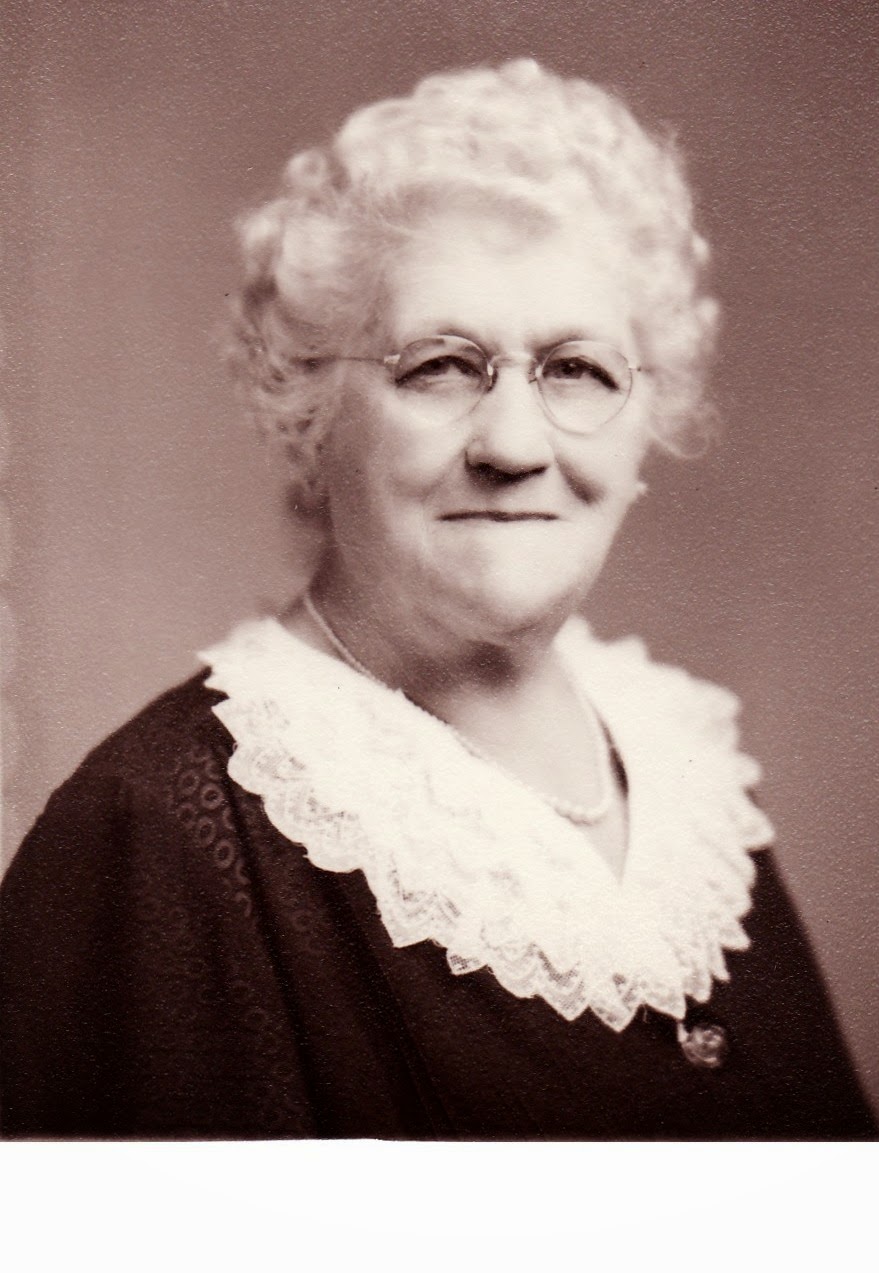


Cora was born on June 8th, 1897 in O'Fallon, Illinois. She was the third daughter of  Gertrude Marguerite Fix and William Constance Powell (affectionately known as Mom & Dad Powell) to reach adulthood.

We are lucky Cora's oldest sister Blanche loved genealogy and family history. Blanche documented the life story of her family members including Cora's. I recently was sent some lovely pictures of Cora and her family by one of Bill Mathias's nieces.  So while posting the pictures, I thought I would document Cora's life.

The first known record of Cora was in the 1900 US census. On June 18th, 1900, her family was living in a rental home in Collinsville, Madison County, Illinois. 3-year-old Cora was living with her parents William (age 29) and Gertrude (29), and her sisters Blanche (8) and Mabelle (6). William's occupation was listed as common laborer. Blanche and Mabelle both attended school in the prior year.


Cora is also listed in the 1910 US census with her parents and siblings. On April 18th, 1910, her family was living on 158 Seminary street in Collinsville, Madison County, Illinois. Her parents William (age 38) and Gertrude (age 27) had been married 19 years and had 6 children all living. It was a first marriage for the pair. William was working in the coal mines. Living with them were Blanche (17), Mabelle (15), Cora (14), George (9), Maude (6) and Dorothy (3 months).


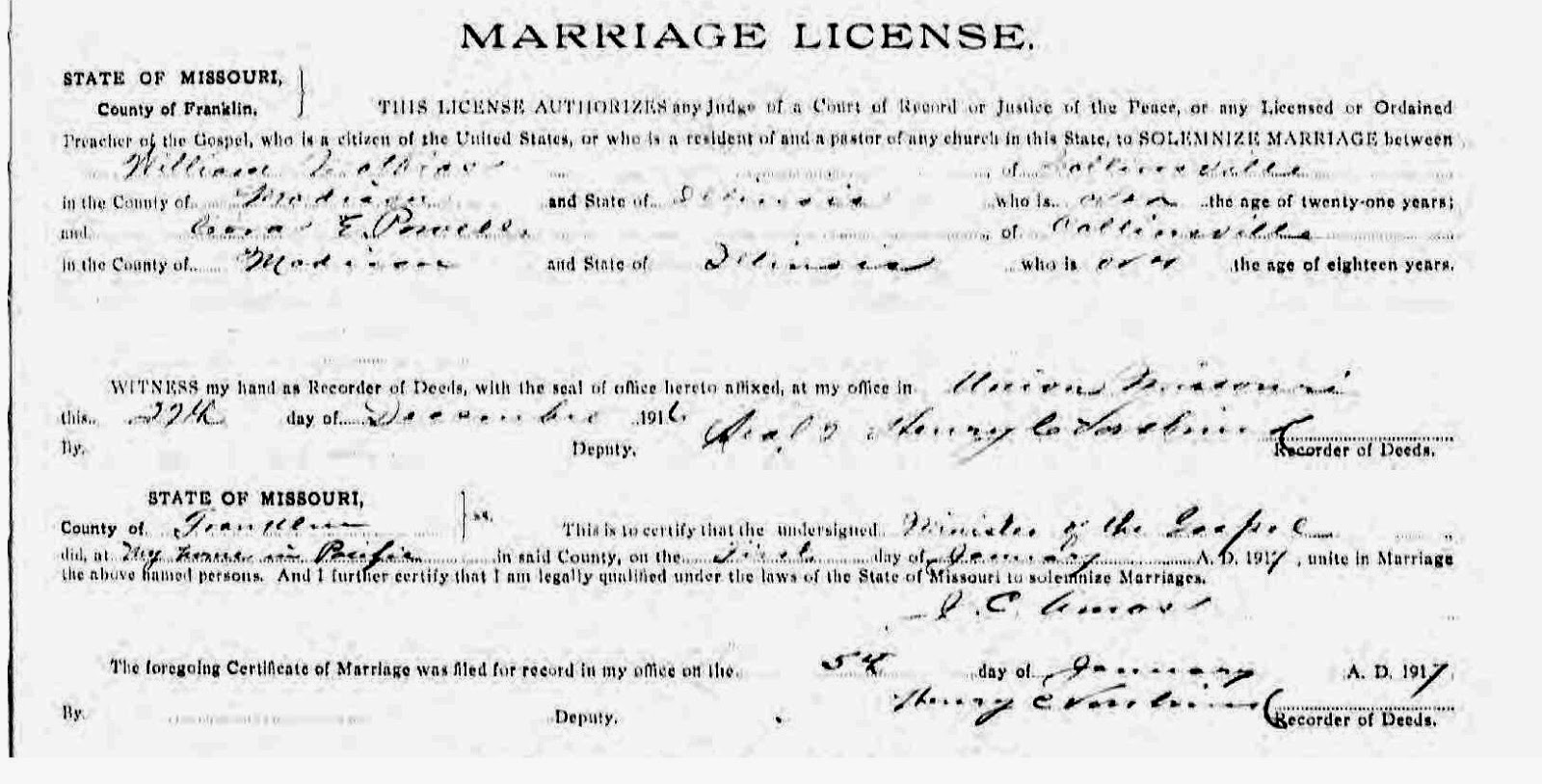
According to Blanche's bio, Cora went to the Normal school and became a teacher. When Cora was 20 years old she married William Mathias. The couple was married January 1st, 1917 in Franklin, Missouri. A copy of the marriage record was obtained from the Missouri Marriage Records, 1805-2002 database in Ancestry.com. The record states both Cora and William were residents of Collinsville.

On March 4th, 1918, Cora gave birth to a baby daughter in St. Clair, County, Illinois. They named the child Gertrude Mae after Cora's mother.

On June 5th, 1918 William and Cora were living in Kansas City, Missouri. On his WWI draft registration card William, a resident of Kansas City, Missouri was employed by the Morris & Co. in Kansas City, Kansas as a clerk. William was born on July 30, 1886 in Decatur, Illinois and had two dependents, a wife and child. He was described as 5'3" tall, 148 lbs., blue eyes, and brown hair. It was notated that he was bowlegged and suffered from hemorrhoids.


It appears the Mathias family didn't stay in Kansas City very long. On August 185h,  1919 Cora gave birth to a second daughter who they named Marguerite Georgette.

According to the 1920 US Census, on January 7th, 1920, the Mathias family was living in Collinsville, Illinois. William, age 31 was working as a stock clerk at a packing plant. With him were Cora age 22, Gertrude 21 months, and Marguerite 5 months. The family had two boarders, Oscar Schneider, age 22 and Ralph Wyatt, age 17.


On August 30th, 1921 Cora gave birth to a son. William Leroy Mathias was born in Collinsville. William would complete their family.

It appears that the Mathias family was missed in the 1930 census. Their street was the dividing line between enumeration districts 23 and 24. The Mathias family was living in the home formerly occupied by her parents located at 258 N. Seminary. The families located at 240, 244 and 264 Seminary were enumerated on page 25 of district 24. It appears the homes at 246, 252, and 258 all enumerated in the 1920 and 1940 censuses were missed.


According to the 1940 US Census, On April 3rd, 1940, the Mathias family was living at 258 Seminary in Collinsville, Illinois in a home they owned. William, age 52 with 2 years of high school education was working as a salesmen in the "Meat W-R" industry with a $3600 income. With him were Cora age 42, with 1 year of college, Margy age 20 with 2 years of college, Gertrude "Atkins" 22 with 3 years of college and her husband Gene Atkins age 23 with 3 years of high school. Gertrude was working as a hospital nurse making $225 and Gene was working as a mechanic at the meat packing plant although the census indicated he had worked all 52 weeks in the previous year, no income was listed for him. The Lorenz family was renting a home at the same address in a separate residence.
Gertrude
Their son Bill was not living at home, he had enlisted in the Navy on January 4th, 1939. In February of 1940 Bill was admitted to the naval hostpial in Honolulu having  been burned while working aboard the USS Dayton. Bill's injury didn't prevent him from serving 11 years in the Navy.


In 1942, 53-year-old William was required to register for the WWII draft. He was living at 960 St. Louis Road in Collinsville, Madison County, Illinois. He was working for the Hunter Packing Company located at 2nd and Lynch in East St. Louis, Ill. The registration card lists his birth as July 30, 1888 in Decatur, Illinois. He listed his wife Cora at the same address as the contact person who would always know where he was.


In 1942, Cora paternal aunt, Elizabeth Powell died. Cora was appointed as the administrator of the estate. 
Family photos document the couple went to Arizona several times to visit with family.


Newspaper clippings show Cora was a member of the Baptist church, and active in the local chapter of the Daughters of Union Veterans (DUV).


The following is a picture of Cora's oldest 2 grandchildren, Jeannie Atkins, daughter of Gertrude born in 1943 and David Stillerman, son of Marguerite.


In January 1967, Cora and Will celebrated their Golden wedding anniversary.


Later that same year Cora passed away on Oct. 2nd, 1967 at the age of 70.  The St. Louis Post-Dispatch listed a burial permit on Oct. 6th for Cora Elizabeth Mathias. My records show Cora was buried in St. John's cemetery in Collinsville, Illinois.

William passed away in October 1976 at the age of 88.


Tuesday, January 28, 2014

John Valentine Gates (1791-1839)

John Valentine Gates (1791 – 1839)
Gone to Texas!


John Valentine Gates, son of Patsy Rossen and Valentine Gates was born in Georgia about 1791. Family trees found on the internet state that John was born in Interence, Georgia. Where the heck is Interence? I've never heard of it. I tried to Google it without success. Nor was it listed on the GeorgiaInfo place names list. So where was John born? According to John’s 1812 military record, he was born in Jefferson Cty, Georgia. [1] 


Sometime before 1798, the Gates family moved to Jackson County is located in northeast Georgia. Settlement in Jackson County began in 1784 with a small group of Revolutionary War Veterans and other pioneers. By 1801, the pioneers had built homes, a church, a grist mill, a small iron foundry, and the first school in the County.


Tax records available on Ancestry.com show that John’s father Valentine paid taxes in Jackson County, in Northeast Georgia in 1798, 1799, and 1801. [2,3]

Name:Valentine Gates
Year:1798
District:Captain Thomas Kirkpatricks Company
Place:Jackson, Georgia, USA

Name:Volintine Gates
Year:1801
District:Captain Nicolas Tuttles Company
Place:Jackson, Georgia, USA

Georgia Tax Index, 1789-1799 about Gates, Valintine

Name:Gates, Valintine
County:Jackson
Year:1799
District:T. REYNOLDS
Page:46

Around 1812, John married Martha Jane Hampton who was born about 1793 in North Carolina. She is said to be the daughter of John Wade Hampton and Joyce Malone. 

Most family trees state the couple was married in Tennessee. I believe the couple was married in Georgia.  I was unable to locate a marriage record in Tennessee or Georgia but my guess of the location of their marriage is based on the following clues:

1)  John and Martha met in Jackson County. Tax records show the Hampton family was living in Jackson County, near the Gates family. [2]
Name:John Hampton
Year:1798
District:Captain Thomas Kirkpatricks Company
Place:Jackson, Georgia, USA

2)  John enlisted in December 1813 in Jackson City, Georgia. [1] 

3) Their daughter Martha Polly Gates (Dean) was born about 1814 in Georgia. [4,5] 


War of 1812


At war with Napoleon Bonapart's French Empire since 1793, Britain claimed the right to intercept American ships on the high seas, seize their cargoes, and search their crews for British navy deserters. By 1811, the British Royal Navy had impressed at least 6,000 mariners who claimed to be citizens of the United States. In addition to impressments, Americans were dismayed by British agitation of the native population on the western frontier. In 1812, the United States declared war against Great Britain. [6]

On December 23, 1813 in Jackson City, Georgia, John Gates an “18 year old farmer” enlisted as a private in the 43rd Georgia Volunteer Infantry Regiment under Captain Edward Tattnall. He is described as 5’9” tall with dark hair, dark eyes, and a dark completion. [1]

In the winter of 1815, the Regiment was defending Fort Peter located on Georgia's marshy coast near the town of St. Marys. On January 15, 1816, 600 British troops landed at a plantation on Cumberland Island. They overwhelmed the small American force, and took Point Peter easily.

John enlisted on December 23, 1813 in Jackson City, Georgia. John an “18 year old farmer” enlisted as a private in the 43rd Georgia Volunteer Infantry Regiment under Captain Edward Tattnall. The record lists his physical description as 5’9” tall, dark hair, dark eyes, and dark completion.  


On January 15, 1816, 600 British troops landed at a plantation on Cumberland Island. They overwhelmed the small American force, and took Point Peter easily. As they headed for the town of St. Marys they encountered 160 American soldiers which included the 43rd Infantry Regiment headed by Tattnall. A skirmish ensued before the badly outnumbered Americans retreated. The skirmish at Point Peter happened almost a month after the peace treaty had been signed. John was discharged at Ft. Moultrie, South Carolina on Sept. 16, 1815. [1]

Sometime after making his way back to his family, John and Martha packed up their belongings and moved to Tennessee. While living in Tennessee, Martha gave birth to a son named Hampton about 1816 and a daughter names Mary Ann (Hawkins) about 1817. 

When Tennessee was admitted to the union, 40% of the land belonged to the Cherokee and Chickasaw nations. An 1818 treaty with the Chickasaw nation secured western Tennessee for settlers. The family moved to Madison County shortly after the treaty was signed. Their son William Norwood was born in Jackson, Tennessee in 1818. 

Perhaps the Gates family was affected by the Panic of 1819. During the War of 1812, American manufacturers found markets in Europe for cotton, tobacco, wheat and corn. The soaring prices led to prosperity that fueled a speculative land boom in the South. When the hostilities ended crop yields in Europe reduced demand for American farm products. Prices plunged, and banks in Europe and America reduced credit. By early 1819 credit was unavailable to many Americans, banks and businesses failed. Sales of public lands plummeted. 

Sometime between 1818 and 1820, the John Gates family again packed their meager belongings and moved to Russellville, Alabama. On the 1820 Alabama State Census, the John Gates family was enumerated in Franklin County. [7]

1 Male      > 21      (John 25)
2 Males    < 21      (Hampton 4 & William 2)
1 female   > 21      (Martha 27)
2 females < 21      (Martha 6; Mary Ann 3)
0 Slaves            
 
While living in Russellville, Martha is said to have given birth to the following children: Francis Caroline (Sanders) about 1820, Bartholomew James about 1823, Joseph Hampton about 1825, Abner Valentine about 1827 and John Jr. about 1829. 

Gone to Texas


Sometime after John was born, the family moved west. Family tradition says the family moved to Natchitoches Parrish, Louisiana and lived there until 1854 when they immigrated to Texas. I was unable to locate the family in the 1830 census. Where was the family? Did they paint “G.T.T.” (Gone to Texas) on their door?

In 1821, Mexico gained their freedom from Spain. Virtually bankrupt and unable to control their borders, Mexico encourage settlement in the sparsely populated northern states. The first Anglo settler colony was established by Stephen Austin in 1822. As news of his success spread, the rush to Texas was on. [8]

In 1824, the Mexican government invited foreigners to become Mexican citizen. If they would swear allegiance to Mexico and their laws, embrace the Catholic religion, occupy and work the land for six years, the immigrants could claim up to 4,605 acres at a cost about four cents an acre ($184) payable in six years. Comparable land in the United States was running $1.25 an acre payable in cash. People packed up everything they owned and headed for the wide open spaces of Texas; they wrote G.T.T. on the doors and fence posts of the abandoned property. [9]


In 1825, the Legislature of Coahuila and Tejas passed a state colonization law which authorized Empresarios to act as land agents for the government. In 1826, Joseph Vehlein, a German merchant, obtained a contract to settle 300 families near Nacogdoches in eastern Texas; John Gates was recruited as settler by Vehlein. [10] On October 16, 1830, Vehlein transferred his contracts to the Galveston Bay and Texas Land Company. [11]


The area that John settled in was wooded; timber was available to construct a cabin. Perhaps he raised livestock. According to the Guide to Texas emigrants there was a good market for cattle, mules, hogs and tamed mustangs in New Orleans. Immigrants who brought slaves to Texas planted cash crops of cotton and tobacco. Although slavery was prohibited, many immigrants ignored the law. There is no record of John bringing slaves to Texas. He could have planted less labor intensive crops of maize, beans, sweet potatoes, oats, barley, flax, rye, and hemp. Wild honey was plentiful and the native grapes were cultivated as well. [12]

 John’s neighbors were mostly Anglos. Between 1821 and 1834, the number of Tejanos (people of Mexican heritage living in Texas) who mostly worked as ranchers and small farmers numbered 4,000. In 1830 the number of Anglo settlers, including slave-owning plantation owners numbered 10,000. By 1834, the number of white Anglo settlers had jumped to 20,700. As more Anglos settled in Texas, tensions increased. [13] 

John settled in the Tenaha district in east Texas (near current day Shelby County, Texas) where the family was enumerated in the 1835 census of Tenaha, as follows: [14] (estimate birth year added by author)

1835 Mexican Census - Teneha            
Gates
John      
Farmer     
47
1788
Gates 
Jane     
Wife        
46
1789
Gates 
Hampton  
Son           
19
1816
Gates 
William  
Son          
17
1818
Gates 
Fanny   
Daughter    
15
1820
Gates 
James   
Son          
12
1823
Gates 
Valentine
Son          
10
1825
Gates 
John, Jr.
Son          
8
1827
Gates 
Samuel   
Son          
6
1829
Gates 
Sarah   
Daughter    
4
1831
Gates 
Susan   
Daughter    
2
1833


Luroy Gates age 23 from Tennessee was enumerated in the Teneha district in 1835. He is listed as a son of John Gates in many of the family trees found on the internet. Perhaps this is why most people say John and Martha were married in Tennessee. [15]   

In 1828 the Mexican government sent a team to investigate the status of the Texas colonies. In a report of their finding the diarist wrote: “the spark that will start the conflagration that will deprive us of Texas, will start from this colony.” The expedition concluded in January 1829. [16]   

Responding to the warnings, in 1830 the Mexican government cracked down on Texas. It ordered Texans to end slavery. It halted further American immigration. It required Texans to pay taxes for the first time. They sent Mexican troops to Texas to enforce collection of customs duties. 

In 1832, blood was spilled. At the Battle of Velasco, Anglo insurgents attacked Fort Velasco. The conflict ended when the Commander was forced to surrender due to lack of ammunition. The troops were allowed to return to Mexico City.

In 1832 and 1833 the Anglo settlers petitioned for reforms and requested a separate state for Texas. [17,18]  Stephen Austin went to Mexico City to present the requests. President Santa Anna agreed to repeal the immigration restrictions, but he refused to grant statehood. Frustrated, Austin wrote an inflammatory letter advising the settlers to proceed without permission of the central government. The letter was intercepted and Austin was arrested. He was freed by a general amnesty law in July 1835 and returned to Texas.

Amid these tensions, John submitted paperwork in 1835 to obtain a deed for land in Texas. He signed the document on May 28, 1835 in Nacogdoches.[19]  

In order to be eligible for land, a settler had to provide proof of good character. Character certificates were issued by local authorities in Nacogdoches to settlers who intended to petition for land grants. Two character certificates were found in the Texas General Land Office (GLO) for John Gates. The first one was written in English. [20] 
Free state of Coahuila and Tejas,
Municipality of San Augustine

I certify that John Gates, a native of Georgia of the United States of America is a man of family consisting of seven persons, and a man of good moral habits industrious and a good citizen and friendly to the laws and religion of the country given at the instance of the party interested.

May 26th, 1835  John Chumley Alcalde interim

The second one was written in Spanish and translated by the author of this bio: [21] 
To the honorable Radford Berry, Mayor of this town and its municipality

I certify that the foreigner John Gates is a man of high morals standards, an adherent of the constitution and laws of the country and the Christian religion; he is married with a family, and been in this area from 1829 until now. It has been proven by witness and oral declaration at the Town of Nacogdoches on 9 Nov. 1835.

G. Pollite Alcalde in Tenna
In 1835, Santa Anna overthrew the constitution of 1824 and appointed himself dictator. He ordered the military to disarm state militias. Soldiers were sent to Gonzales, Texas to repossess a cannon provided to the residents for defense against Indian raids. On October 2, the Texans loaded the cannon with scrap iron, and fired at the troops. Outgunned the soldiers retreated. War had begun. [22] 
The colonists formed an ad hoc Army and marched to San Antonio de Béxar where they laid siege to the garrison housing 1200 troops under the direction of General Cos. After about 2 months, the stalemate ended when Col. Ben Milam appealed to the Texans "Who will go with old Ben Milam into San Antonio?"
Before dawn on December 5, Milam and 300 volunteers attacked the town. Milam was killed by a sniper during the house-to-house combat. After four days of fighting, General Cos signaled a truce. In exchange for the parole and return of Cos and his men to Mexico, the Texans gained controls of the public property, guns and ammunition in San Antonio.

John’s 17 year old son William Norwood joined Ben Milam in the storming of San Antonio. In William’s pension application he described his service as follows:

“I was at San Antonio with Col. Milum when he fel and then after whiping Coss out of the alamo I returnd home I belonged to Baly Anderson Company I got home in January 36 I was in the battle of San Antonio yours truly, W.N. Gates”. [23] 


After the battle William returned home to his family (near current day Shelby County, Texas). William was credited with service to the Republic of Texas for which he received a Bounty Warrant No.179 for 320 acres of land. [24] 
In February 1836, Santa Anna led the Mexican Army into Texas to put down the rebellion. The troops arrived in San Antonio on Feb. 23. The Texans defending San Antonio took refuge inside the Alamo. After a thirteen-day siege, Mexican troops stormed the Alamo and killed all rebel fighters sparing only a few women and slaves.
Santa Anna and his troops then continued east. General Jose Urrea marched additional troops up the Texas coast. Houston retreated leaving the settlers unprotected. Fearing Santa Anna’s policy of taking no prisoners, Texans fled their home and took refuge in Louisiana.
On April 21, 1836, the Texans defeated Santa Anna's army at the Battle of San Jacinto; Santa Anna was captured the following day. The Mexican army retreated back to Mexico City, ending the Texas Revolution.

It appears the Gates family was among the Texans who fled to Louisiana. John settled in Natchitoches Parrish, Louisiana. A land patent show John Gates acquired 160 acres in Township 10N, Range 10W, southeast quarter section 29. [25] According to the BLM tract books, John bought 159.90 acres at $1.25 per acre on February 5, 1939. [26] Natchitoches Parrish contained vast cotton and tobacco plantations. It is likely that the family farmed the land growing cash crops of cotton or tobacco as well as garden crops to feed the family.

Family tradition states John died in 1837 in Natchitoches leaving behind his wife Martha Jane and several under age children. Based on the land records, John’s death was after Feb. 1939.[27]  The patent for John Gates was recorded on April 1, 1843. The deed may have been recorded when the property was sold or divided to satisfy John’s estate.

It is possible that after John’s death, Martha married a second time. An entry found on a message board posted by Jane Skjothaug May 22, 2002 stated:

Martha Gates, widow of John Gates, married James Maxwell between 1840 and 1842 probably in Natchitoches Parish. Need to know when. In a law suit filed against her Dec. 1842 by Geo. Fuller in Natchitoches Parish it states that "Martha Gates, widow of John Gates, newly married to James Maxwell, is leaving the state of LA forever". She signed the note for a loan under the name Martha Gates. [28] 

James and Martha moved to Hopkins County, Texas before 1847. The last known location of the couple was Hopkins County, Texas where they were living when the 1850 census was taken. [29] 

John and Martha’s children must have requested assistance in obtaining land bounty based on their father’s Mexican land grant. On February 3, 1860 An Act for the relief of the heirs of John Gates was passed by the Texas legislature. This act cancelled the title issued to “John Gates as a Colonist in Vehlin’s Colony” and issued a certificate to his heirs.[10] 

Paper work dated 1878 listed his heirs as: W.N. Gates; A.V. Gates, Mary Hawkins, Avarilla Gates (widow of Bartholomew), Caroline Sanders, and Joseph Gates. [30]  At least one sibling who was still living was not included as an heir, Samuel who was living in Florida; perhaps he had lost touch with his siblings.

Researchers credit the following children to the couple:


Name                             
Birth          
Death           
Leroy 
1812 TN
Martha Polly (Dean) 
1814 GA
1862 MS
Joseph Hampton
1816 TN
after 1878
Mary Ann (Hawkins)
1817 TN
abt  1900 IL
William Norwood
1818 TN 
1903 TX
Francis Caroline (Sanders) 
1820 AL 
1876 TX
Bartholomew James 
1823 AL
1860 LA
Abner Valentine
1825 AL
1916 TX
John, Jr.
1827 AL
Samuel
1830 TX
1890 FL
Sarah
1831 TX 
Susan
1833 TX 
Martha Emaline (Parsons) 
1837 LA 
1855 TX


[2]   Ancestry.com, Georgia, Property Tax Digests, 1793-1893. Georgia Tax Digests [1890]. 140 volumes. Morrow, Georgia: Georgia Archives.
[3]   Ancestry.com, Georgia Tax Index, 1789-1799
[4]   1850 United States Federal Census, Summerfield, Dallas, Alabama, Martha Dean born abt 1813 in GA
[5]   1860 United States Federal Census, Summerfield, Dallas, Alabama, Martha Dean born abt 1814 in GA
[6]   USS Constitution Museum, Short History of the War of 1812, accessed 28 Sep 2013.
[7]   Ancestry.com, Alabama State Census, 1820-1866, Franklin County, John Gates
[8]   The hidden history of Texas. Part 2; The Rag Blog By Bob Feldman August 16, 2011
[9]   Anglo-American Colonization, The Handbook of Texas
[10] The Laws of Texas 1822-1897: Volume 5, Chapter 87, Page 98 (Google eBook) An Act for the Relief of the heirs of John Gates, Legislature of the State of Texas, Feb. 3, 1860
[11] Empresario Contracts in the Colonization of Texas 1825-1834, Sons of DeWitt Colony Texas website
[12] Guide to Texas Emigrants, 1835 by David Woodman, Jr. Page 34, The Portal to Texas History
[13] The hidden history of Texas. Part 3; The Rag Blog By Bob Feldman August 24, 2011
[14] 1835 Census of Tenehaw (Shelby County), Shelby County Historical Society Museum & Library, Shelby County, Texas
[15] The First Census of Texas, 1829-1836, Special Publication of the National Genealogical Society, 1962, Page 8
[16] Manuel de Mier y Terán 1789-1832, Sons of DeWitt Colony Texas website
[17] Convention of 1832, Lone Star Junction edited by Lyman Hardeman, Convention of 1832
[18] Convention of 1833, Lone Star Junction edited by Lyman Hardeman, Convention of 1833
[19] Texas General Land Office Land Grant Search, John Gates, Unfinished Titles, file number SC 000060:29 - Page 11, Petition #394 - John Gates
[20] Texas General Land Office Land Grant Search, John Gates, Character Certificates, file number SC 000067:8
[21] Texas General Land Office Land Grant Search, John Gates, Character Certificates, file number SC 000087:53
[22] The Battle of Gonzales, By Christopher Minster, About.com Guide
[23] Texas General Land Office Land Grant Search, William Gates, Republic Donation Voucher 001008
[24] Texas General Land Office Land Grant Search, William Gates, Houston Bounty 000152
[25] Bureau of Land Management, Natchitoches, Louisiana land office, Patentee John Gates, Document number 260
[26] Bureau of Land Management Tract Books, 1820-1908, Louisiana, Vol. 19 Image 36, Familysearch.org
[27] Natchitoches - Family History & Genealogy Message Board, Ancestry.com, posted Posted: 22 May 2002 by JaneSkjothaug
 [28] 1850 United States Federal Census, District 8, Hopkins, Texas, Martha Maxwell born abt 1795 in North Carolina.
[30] Texas General Land Office Land Grant Search, John Gates (Heirs), Hemphill County, Bexar 1st  file 001900